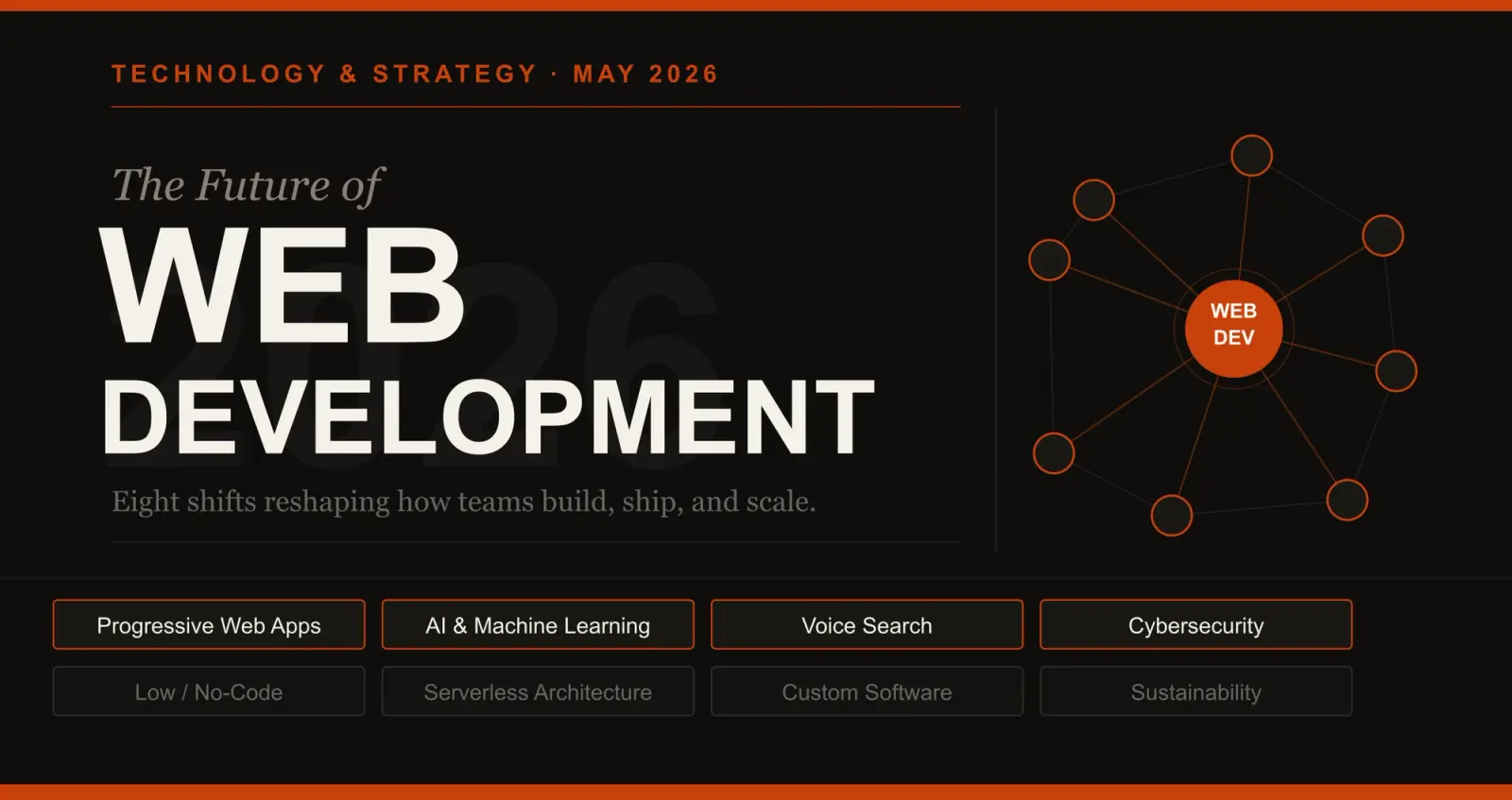
Eight shifts reshaping how teams build, ship, and scale — and why the companies that act now will lead their categories tomorrow.
Introduction
The web is not standing still. In 2026, the gap between teams that embrace emerging development practices and those that don’t is widening — measurable in page speed, conversion rates, security posture, and the ability to ship features before competitors do.
Whether you’re an enterprise evaluating a custom software development company or a growth-stage startup mapping your technology roadmap, understanding where the industry is heading isn’t optional. It’s a strategic advantage.
Below are the eight trends defining modern web development this year — and what each one means for your business.
“The question is no longer whether to adopt modern web technologies. It’s whether you’ll do it before your competitors do.”
Eight Trends Defining 2026
These eight forces are reshaping web strategy for U.S. businesses in 2026:
1. Progressive Web Applications (PWAs)
PWAs deliver app-like experiences — offline access, push notifications, home-screen installation — without requiring an app store. In 2026, PWAs help teams ship faster across devices while controlling costs versus fully native builds. They improve SEO and discoverability and boost engagement with reliable performance even on spotty networks. For commerce, content, and portal use cases, a PWA is often the quickest path to measurable ROI.
2. AI and Machine Learning Integration
AI/ML has moved from experiments to embedded features. Modern teams are shipping smarter search, personalized recommendations, conversational support, and automated testing — not as roadmap items, but as live product features generating measurable lift. AI-assisted coding tools are also compressing development timelines significantly. The key in 2026 is pairing these gains with governance: privacy-by-design, clear data pipelines, model monitoring, and DevSecOps embedded from the start.
3. Voice Search Optimization
Conversational content, structured data (schema markup), fast page speed, and accessibility are the new table stakes as voice assistants handle more discovery queries. Businesses that optimize for voice search now are positioning themselves for a channel that continues to grow in reach and commercial intent.
4. Enhanced Cybersecurity Measures
Security is shifting left — embedded in CI/CD pipelines through DevSecOps rather than bolted on after launch. In an era of escalating threats, enterprise-grade web development means treating compliance and security as foundational architecture, not an afterthought. Non-negotiable in 2026.
5. Low-Code and No-Code Development
Low-code and no-code platforms are powerful for validating ideas and building internal tools quickly. The best results come when governance guardrails and integration patterns ensure prototypes can scale or be hardened by engineers. Without that structure, teams risk technical debt that compounds rapidly.
6. Serverless Architecture
Serverless shifts infrastructure management to the cloud, letting you run backend code and consume managed services that auto-scale and bill per use. It’s ideal for APIs, event-driven workloads, and spiky traffic where speed-to-market and elastic scale matter most. An API-first design, stateless functions, and strong observability help teams capture serverless benefits without surprises.
7. Custom Software Solutions
Off-the-shelf platforms have ceilings.Custom software solutionsaligned to your specific workflows, data model, and competitive context create durable differentiation that generic tools simply can’t match. In 2026, more enterprises are making this shift — and doing so earlier in their growth journey.
8. Sustainability in Web Development
Optimized assets, smarter caching, and efficient hosting aren’t just green choices — they reduce infrastructure costs, improve Core Web Vitals, boost SEO rankings, and support corporate ESG goals. Performance and sustainability are increasingly the same initiative.
The Role of Custom Software Development Companies
Every trend listed above has an implementation layer — and that’s where **custom software development companies **earn their value. Translating a trend into a secure, scalable outcome requires coordination across design, backend architecture, cloud infrastructure, and security. It’s a systems problem, not a tools problem.
A seasoned **custom software development agency **doesn’t sell you a framework. They start with discovery and roadmapping — understanding your competitive context, data model, and compliance requirements — then architect toward outcomes that compound over time.
Core custom software development services that map to 2026 priorities:
- Application modernization— migrating legacy systems to API-first, cloud-native architectures without disrupting operations
- PWA and web app development— shipping fast, reliable, cross-device experiences that outperform native apps on discovery and distribution
- AI feature integration— selecting fit-for-purpose models, integrating them with your stack, and maintaining them with proper observability
- Cloud and serverless enablement— designing stateless, auto-scaling backends with strong observability from day one
- DevSecOps implementation— embedding security in CI/CD pipelines so compliance and safety are built-in, not bolted on
Mobile Integration: One Backbone, Every Device
For businesses where mobile is a primary channel, the most efficient architecture shares APIs, authentication, and data logic between your web platform and native apps. An Android app development company working in concert with your web team — or a custom software shop that handles both — prevents the expensive divergence that happens when mobile and web are built in silos.
The goal is one reliable backbone that meets users wherever they are: browser, app, or voice assistant.
Ready to Build What’s Next?
Whether you’re modernizing a legacy platform or architecting something from scratch, a seasoned custom software development partner can help you move from trend awareness to measurable results.