Ask a brokerage owner how many leads they bought last month and you'll get a number instantly. Ask how many of those leads nobody ever replied to and the room goes quiet.
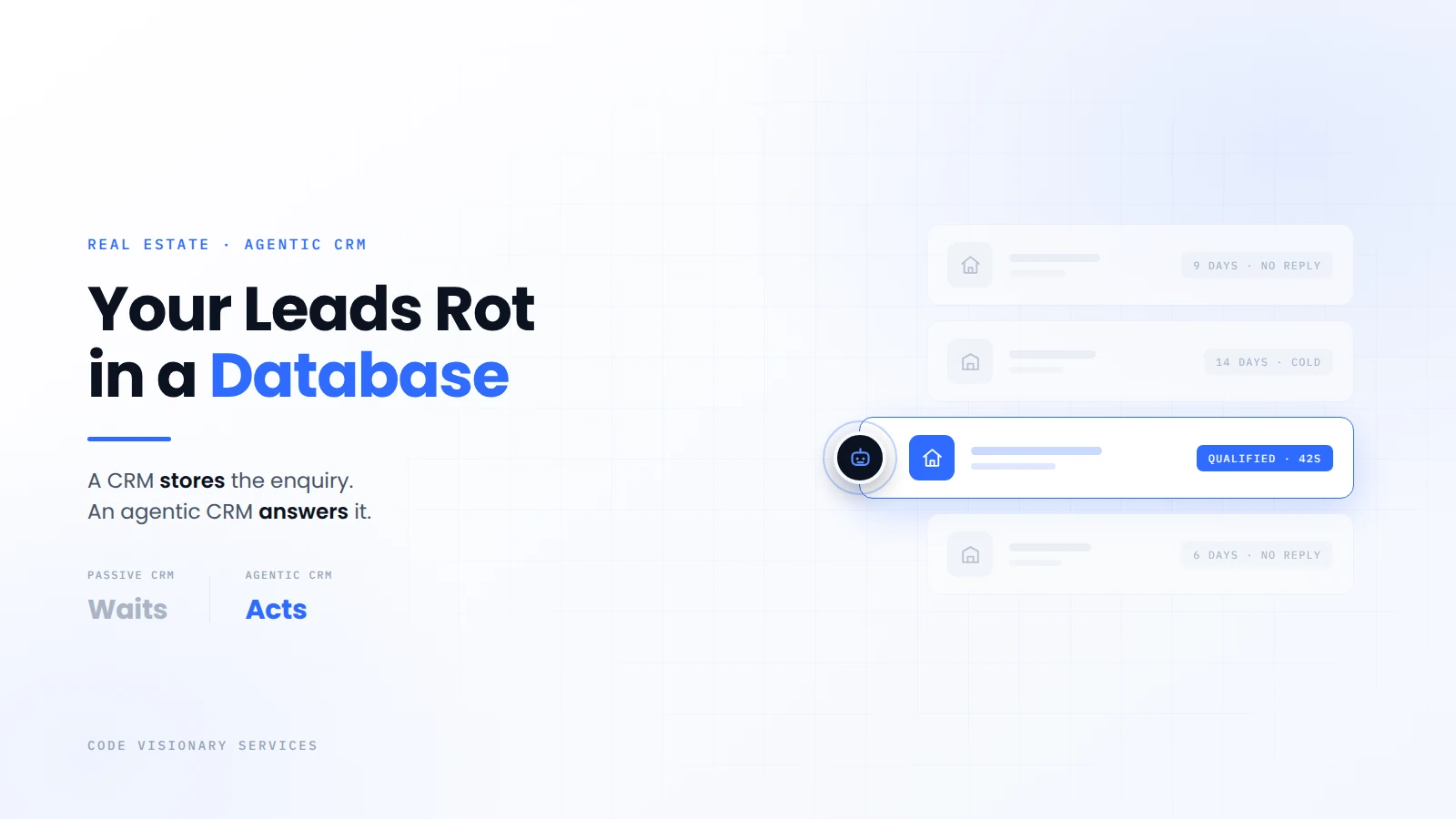
That gap is the problem with most real estate CRM software. The CRM did its job: it stored the lead. It just has no opinion about lead 400 sitting untouched for nine days while your agents work the ones that came in this morning. A database waits to be asked.
An agentic CRM doesn't wait. Same records, same pipeline, but with AI agents that have the authority to act on what they see: answer the enquiry, ask the qualifying questions, update the record, escalate the deal that's stalling. In a business where speed decides who gets the viewing, that's not a small change.
Why real estate breaks passive CRMs specifically
Plenty of industries survive a slow CRM. Real estate doesn't.
Your leads arrive at the worst possible times. Enquiries come in at 11pm on WhatsApp, or through a portal form while your agent is at a site visit with someone else. A CRM that only moves when someone logs in is offline for most of the hours your buyers are actually shopping.
Those buyers are also shopping elsewhere. Someone enquiring about a two-bedroom has enquired about four other two-bedrooms the same evening. Whoever answers first gets the conversation; the other four get a CRM record and nothing else.
And your field team isn't at a desk. Asking agents to log a site visit, update a stage and set a follow-up reminder accurately, from a phone, between appointments, is asking for data that will be wrong by Wednesday. Then the Monday pipeline report gets built on it and presented as if it were true.
What "agentic" actually means here
The word gets thrown around loosely. An agentic CRM has at least four behaviours, and a product with none of them is a database with a chat widget on it.
The first is that it answers before a human does, and not with a canned FAQ response. It asks what your best salesperson would ask: budget, area, timeline, whether they're financing or paying cash. Then it scores what came back and routes the serious ones to a person, with a summary rather than a transcript nobody will read.
The second is that it follows up without being told. The second and third touch is where most real estate pipelines die, because nobody's job is "message the person who went quiet."
Third, it notices what's going cold and tells you, instead of waiting for you to open a report. Deal in negotiation, no contact in eleven days, nothing scheduled. Finding that deal should not depend on someone scrolling a list.
Fourth, it polices its own data: document expiry, missing fields, a lead with no owner, an agent handing out a personal number instead of keeping the conversation on-platform. These are all checkable conditions. In a passive CRM they stay checkable and never get checked.
What we built, and what we learned building it
We'd be guessing about most of this if we hadn't shipped it. Asobr CRM is a real estate CRM we built for the UAE market: a web dashboard, a Flutter app for field agents, and an AI agent called Aria that handles inbound leads across WhatsApp, Instagram and Facebook around the clock.
Aria qualifies before any human agent is assigned. She filters spam, captures contact details and reads buying intent from the conversation rather than from a form field. That ordering is what matters: by the time a human picks up the lead, the junk is gone and the basics are already in the record, so the agent's first message is about the property instead of about data the buyer already typed once. Giving Aria the authority to reply and write records herself is what puts Asobr on the agentic side rather than being a system of record with AI bolted on.
The lead analytics module covers what managers actually ask for: leads, deals, conversion rate, revenue and quality score per channel, plus cost versus revenue by channel, which is the number most brokerages don't have anywhere in one place. It also flags lead leakage. When an agent shares personal contact information with a lead, the system spots it, alerts, and can temp-ban automatically.
Lead leakage is the example I use when someone asks why the agentic framing matters. Every CRM already has the data needed to detect it sitting in the message log. None of them look, because looking isn't a stored procedure anyone wrote. Compliance works the same way: in Asobr, daily jobs check RERA card and Emirates ID expiry and temp-ban agents whose documents lapse, so nobody maintains a spreadsheet of expiry dates.
We've since carried the same patterns into OrbitCRM, our own CRM product, for teams with a pipeline problem of the same shape who aren't in UAE real estate.
Where it goes wrong
This is where most vendor content stops. Two warnings, both learned the expensive way.
Agents make bad data worse. If your pipeline is full of stale stages and half-empty records, pointing an autonomous agent at it produces confident nonsense at speed. Data cleanup isn't a phase you skip because the AI is clever. It's the prerequisite.
And autonomy without an escalation path reaches customers. An agent that can't tell when it's out of its depth will answer anyway. You need a confidence threshold that hands off to a human, a hard boundary around anything touching price or contracts, and a log detailed enough to reconstruct why the agent did what it did on a specific deal. If you can't answer "why did it say that" three weeks later, you don't have a system you can defend to a client.
Advice that costs us work sometimes: start with your worst bottleneck. If leads wait too long for a first reply, agents pay for themselves quickly. If your agents don't update the CRM at all, fix that before automating on top of it.
Four questions worth putting to any vendor, including us. Can it act without a human trigger, and can you see what it did yesterday? Can your sales lead change the qualifying questions without an engineering ticket? Does it work on WhatsApp? And when it's unsure, does it guess or escalate? Push hardest on the last one, because it's the question that reliably gets hand-waved.
Where CVS fits
We build real estate CRMs and the agents that run inside them. Sometimes that's a platform like Asobr. More often it's AI lead qualification sitting on top of the CRM a brokerage already runs, because replacing a system of record and introducing agents at the same time is two risky projects pretending to be one. Where follow-ups and CRM hygiene are the real problem, that's sales ops automation, and the channel-ROI reporting layer is analytics dashboards.
If you're evaluating CRMs and want a straight read on whether agents would help your pipeline or just add a bill, tell us what your funnel looks like. If the honest answer is cleaner data and a follow-up habit rather than an AI agent, we'll say so.
FAQs
Q1: What is an agentic CRM for real estate?
It's a real estate CRM where AI agents take actions on their own instead of waiting for an agent to click something. They answer inbound enquiries, ask qualifying questions, update records, flag deals going cold and enforce data rules, while the human team handles viewings, negotiation and closing.
Q2: Do we have to replace our current CRM?
Usually not. In most of our deployments the AI agent sits on top of the existing CRM and reads and writes through its API. Replacing the system of record is a separate decision and generally shouldn't happen in the same quarter.
Q3: Can an AI agent handle WhatsApp and Instagram enquiries?
Yes, and in real estate it has to. Asobr's Aria agent handles leads across WhatsApp, Instagram and Facebook, because that's where property enquiries actually arrive. A CRM agent that only works on web forms misses most of the pipeline.
Q4: What stops the AI from saying something wrong to a buyer?
Scope limits and an escalation path. Keep the agent on first response and qualification, require a human for anything involving price, contracts or legal commitments, and set a confidence threshold that routes uncertain conversations to a person. Without those, mistakes reach customers unnoticed.
Q5: How do we know if our brokerage is ready for one?
Check whether your current records are accurate enough to act on. If stages are stale and fields are half-empty, clean that first, because an autonomous agent working from bad data just makes faster mistakes. If your data is reasonable and your real problem is response time or follow-up discipline, you're ready.