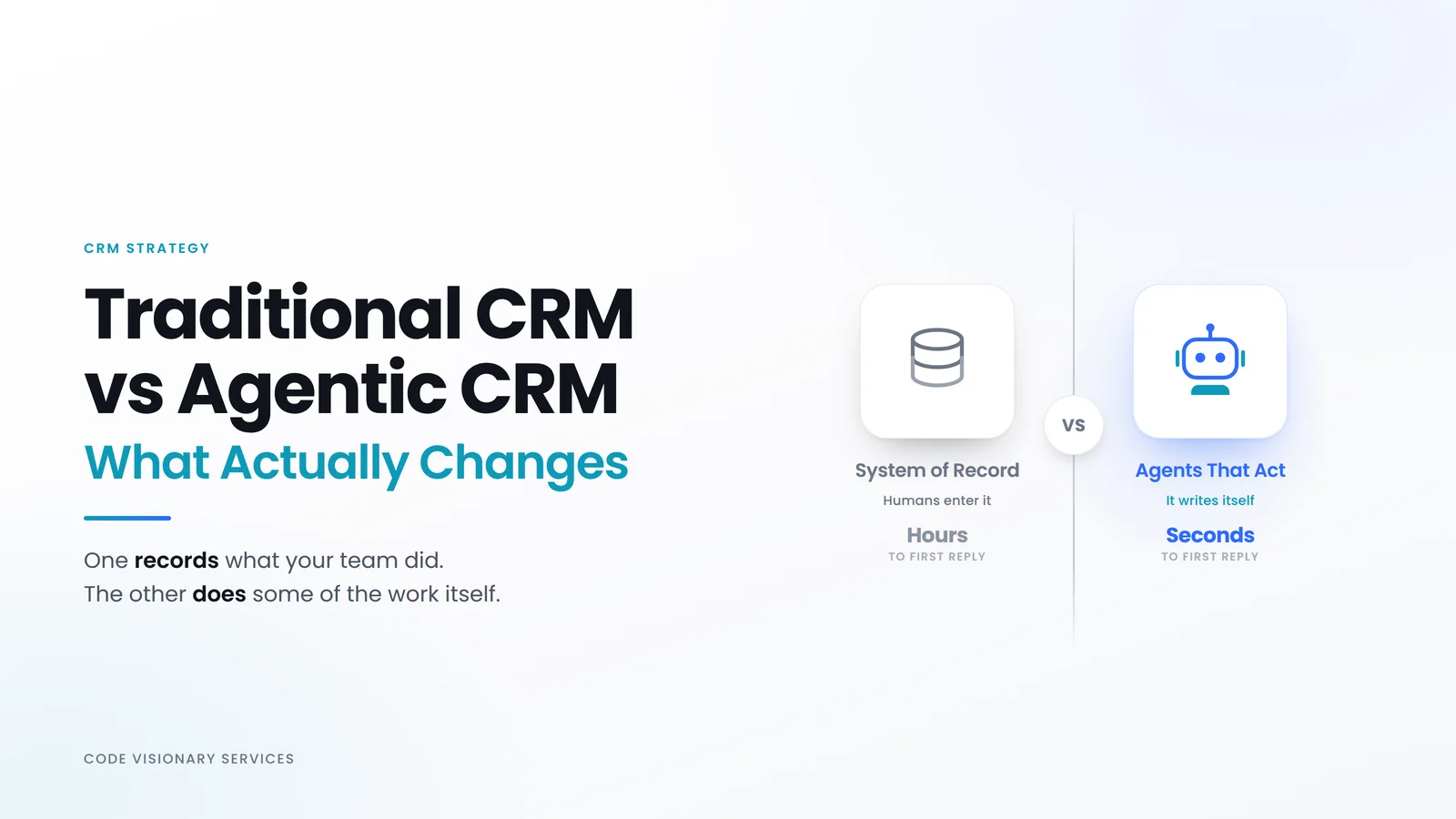
A traditional CRM is a system of record: your team enters the data, and the CRM stores, sorts and reports on it. An agentic CRM adds AI agents that act on that data on their own, replying to leads, updating fields, scheduling follow-ups and escalating deals without waiting for someone to click a button. Traditional CRM fits teams with a stable, low-volume pipeline and strict process control. Agentic CRM fits teams losing deals to response time and admin drag, and who can live with less predictable behaviour.
The distinction matters more than the marketing makes it sound, because these two things fail in completely different ways. A traditional CRM fails quietly, with stale data nobody trusts. An agentic CRM fails loudly, by doing something you didn't expect on a live deal. Knowing which failure you can afford is most of the decision.
What Is a Traditional CRM?
A traditional CRM is a database with a sales-shaped interface on top. Contacts, companies, deals, stages, activity logs. Everything in it arrives because a human put it there, whether by typing, importing a CSV or connecting a form.
Automation exists, but it's rule-based. If a deal moves to "Proposal Sent", send template 4. If a lead hasn't been touched in seven days, flag it. You define every branch in advance, and the system follows it exactly. That predictability is the product. Salesforce, HubSpot, Zoho and Pipedrive all work this way at their core, whatever AI features have been bolted on since.
The important thing is what a traditional CRM doesn't do: it doesn't decide anything. It waits.
Where Traditional CRM Works Well
If every buyer message needs a compliance-approved answer, you want a human in the loop and an audit trail of who said what. Ten enterprise deals a quarter don't need an agent either; they need a rep who knows the account. And if your team already works the pipeline consistently, a CRM that just records it is enough.
Budget is the other honest argument. A traditional CRM costs the same every month whether you close two deals or two hundred, which makes it easy to defend to whoever signs off on spend.
Where Traditional CRM Breaks Down
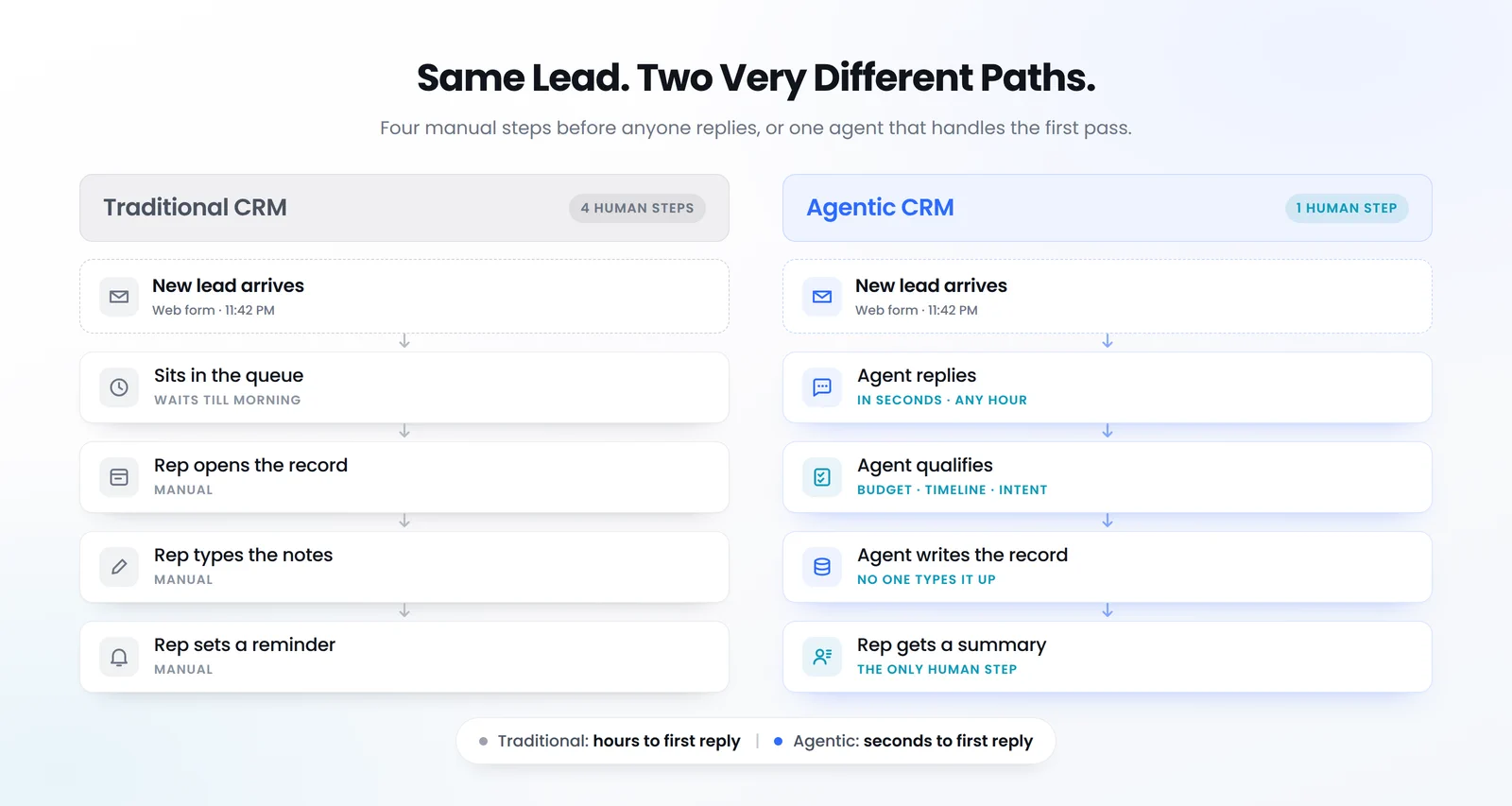
The failure mode is always the same, and it's rarely the software's fault. The CRM is only as good as what people type into it, and people stop typing. Notes get thinner, stages go stale, and six months later the pipeline report is fiction. Nobody notices because nothing errors out.
Then there's response time. A traditional CRM can alert a rep in a second, but it can't answer the lead. If enquiries arrive at 11pm or on a Sunday, they wait. Research on lead response has shown repeatedly that the chance of qualifying an enquiry drops sharply past the first few minutes, and most teams are measured in hours.
And rule-based automation has a ceiling. Every new edge case is a new rule. After two years you have a sequence nobody fully understands and everybody's afraid to change.
What Is an Agentic CRM?
An agentic CRM runs AI agents inside the CRM with permission to act on their own rather than only suggest. The agent is given a goal ("qualify inbound leads and route the serious ones"), a set of tools (read the inbox, send a reply, write to a record, book a slot, ping a rep) and boundaries. Then it works the queue on its own.
The practical difference from "AI features in a CRM" is authority. A summarise button is a feature. An agent that reads a WhatsApp message at 2am, asks about budget and timeline, scores the answer, writes it into the deal record and assigns the right rep before anyone wakes up is a different category of thing.
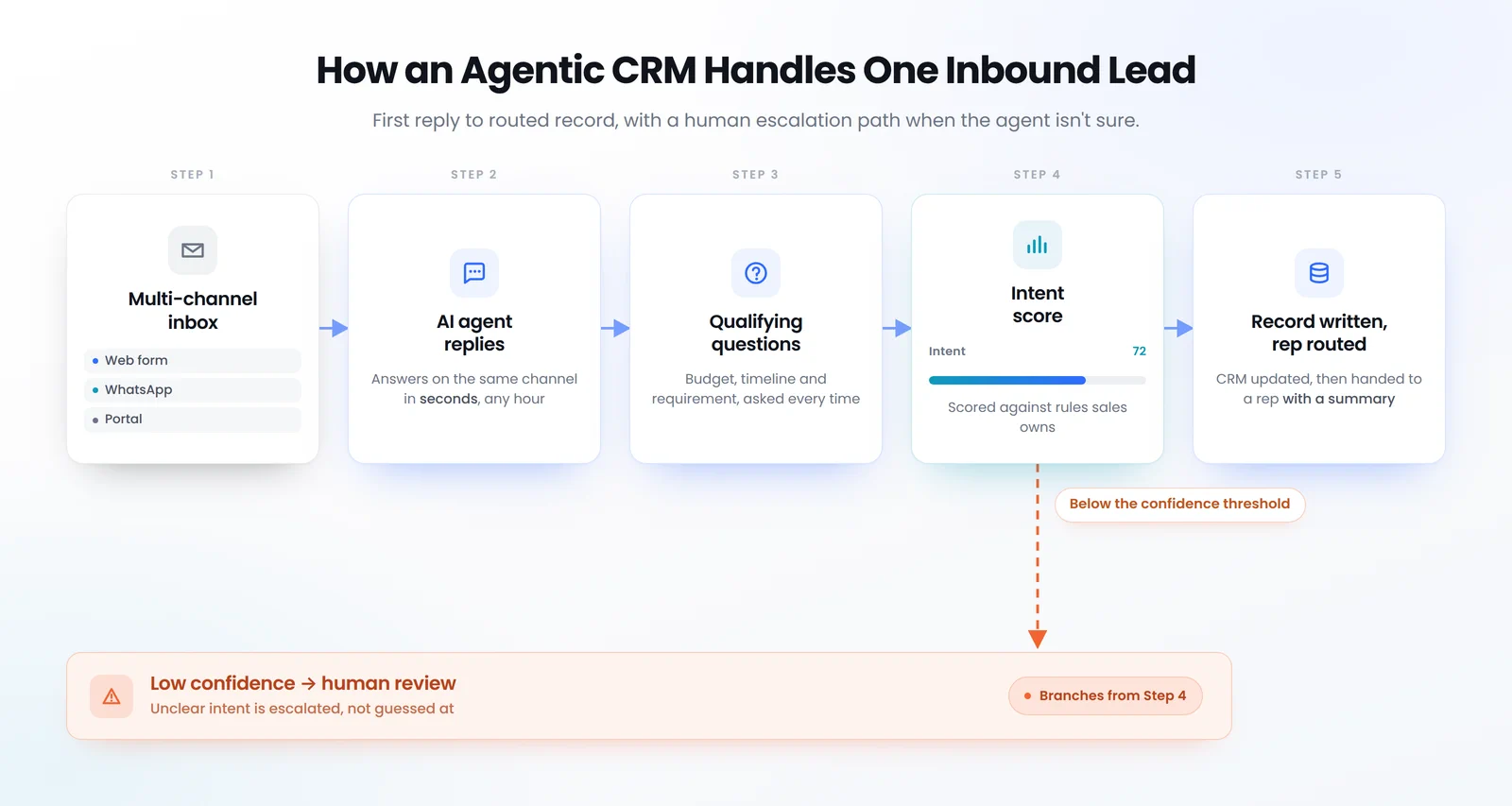
This is the model behind Aria in Asobr CRM, the real-estate platform we built for the UAE market. Aria handles inbound across WhatsApp, Instagram and Facebook, filters spam, captures contact details and detects buying intent before a human agent is assigned. The agent isn't advising the team, it's doing the first pass.
Where Agentic CRM Earns Its Keep
Speed is the obvious one. Replies land in seconds, at any hour, on whatever channel the lead used. In the Asobr deployment, median first response dropped to 38 seconds.
The admin problem also mostly goes away, because the agent writes the record itself. It had the conversation, so there's nothing to type up afterwards, and data entry stops being the chore reps quietly skip.
Volume stops being a headcount question too. Doubling enquiries doesn't mean doubling the people who triage them, and every lead gets the same qualifying questions, including the ones arriving while your best rep is on holiday.
The part that surprises people is how it handles the unscripted. An agent can deal with a question nobody wrote a rule for, which is exactly the point where rule-based automation gives up and dumps the lead on a human.
The Real Drawbacks of Agentic CRM
This is the part vendors skip, so here it is plainly.
It is genuinely unpredictable. Give the same agent the same lead twice and you may get two different phrasings, occasionally two different judgments. For sales copy that's fine. For a quote, a discount or a compliance statement, it is not. You have to decide up front which actions the agent is never allowed to take alone.
It can be confidently wrong. An agent that misreads intent doesn't flag uncertainty, it writes a clean, plausible summary that happens to be wrong. A rep trusting that summary calls the wrong lead with the wrong pitch. Traditional CRMs have gaps; agentic CRMs have gaps that look filled.
Costs move with volume. Every conversation is inference spend. A traditional CRM costs the same in a slow month; an agentic one costs more in a busy one. That's usually worth it, but it's a variable line item and it belongs in the model before you sign anything.
Debugging is harder. When a rule-based sequence misfires, you read the rule. When an agent does something odd, you're reading conversation logs and reasoning traces to work out why. Teams without anyone technical end up unable to explain their own system.
Bad data becomes an active risk. In a traditional CRM, messy records mean messy reports. In an agentic one, the agent acts on those records and propagates the mess into live customer conversations.
There's a trust curve. Reps who have watched the agent get one deal wrong will double-check everything for months, which erases the time it was supposed to save. You get past this with a narrow initial scope and visible escalation, not with a training session.
Traditional vs Agentic: The Honest Comparison
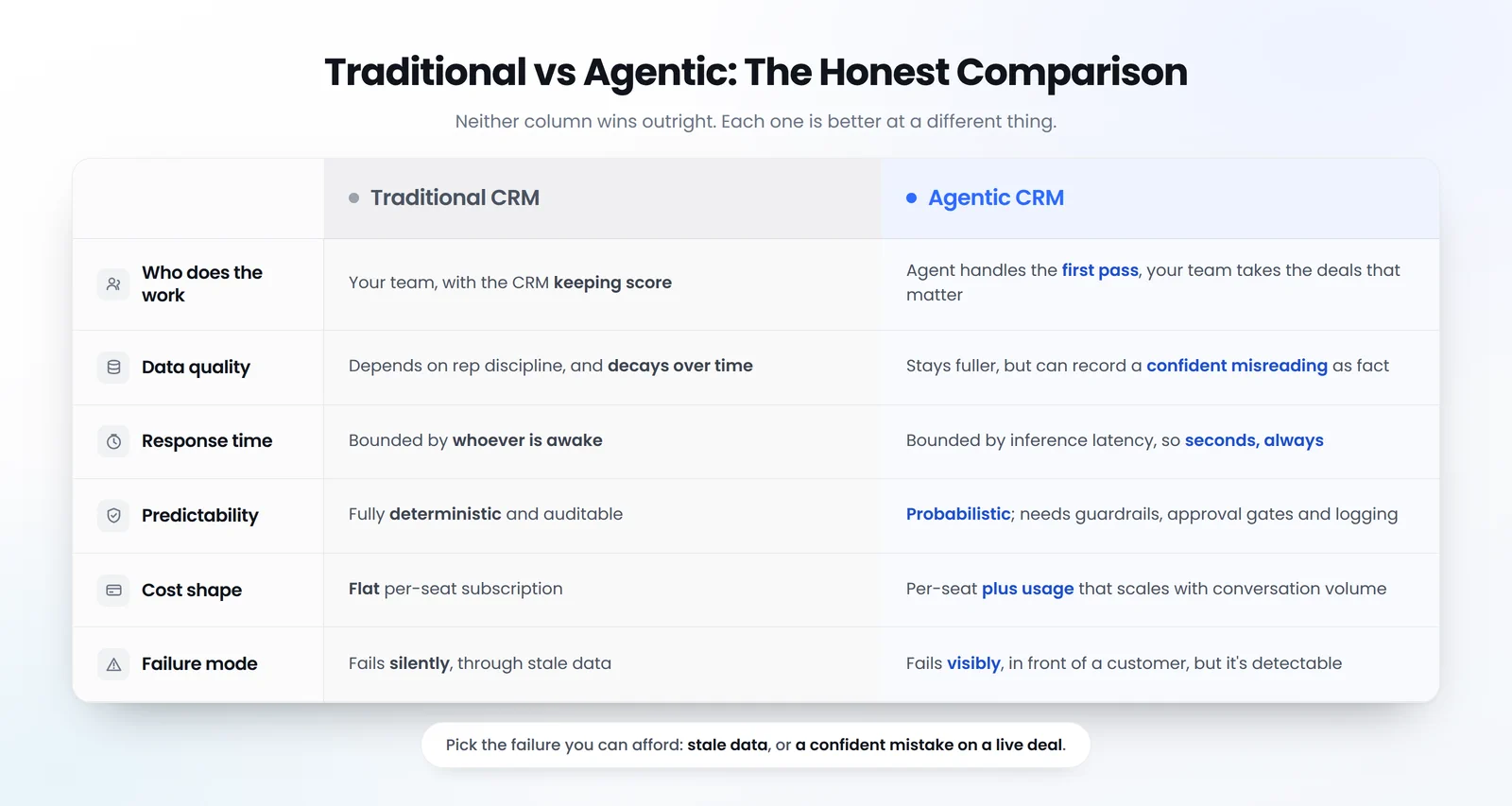
Who does the work. Traditional: your team, with the CRM keeping score. Agentic: the agent handles the first pass, your team handles the deals that matter.
Data quality. Traditional depends entirely on rep discipline and decays over time. Agentic stays fuller because the agent writes what it observed, but it can record a confident misreading as fact.
Response time. Traditional is bounded by whoever is awake. Agentic is bounded by inference latency, so seconds, always.
Predictability. Traditional is fully deterministic and auditable. Agentic is probabilistic and needs guardrails, approval gates and logging to stay controllable.
Cost shape. Traditional is a flat per-seat subscription. Agentic is per-seat plus usage that scales with conversation volume.
Failure mode. Traditional fails silently through stale data. Agentic fails visibly, in front of a customer, which is uncomfortable but at least detectable.
Best fit. Traditional suits stable processes, low volume and strict control. Agentic suits high volume, multi-channel enquiries and response time that's costing you deals.
When to Pick Which
Stay traditional if your pipeline is under roughly fifty active deals, buying cycles run months, every outbound message needs approval, or nobody on the team can own an AI system once it's live. A well-run traditional CRM beats a badly governed agentic one every time.
Go agentic if leads arrive faster than anyone can triage, enquiries land across several channels at once, first response regularly takes hours, or your reps spend more time updating records than talking to buyers. The clearest signal is a rep saying "I didn't get to those yet" about leads from two days ago.
The middle option most teams should take: keep the traditional CRM as the system of record and put an agent on one narrow job, usually inbound qualification. The agent handles first response and scoring; humans own the pipeline from first call onward. You get the speed without betting the whole revenue process on a probabilistic system. That's how nearly every one of these deployments should start, and it's what we recommend when clients ask to agentify everything at once.
Questions Worth Asking Before You Switch
- Which actions would you never let an AI take without a human approving first?
- If the agent misreads a lead, who catches it, and how fast?
- What happens to the agent's work when the model provider changes pricing or deprecates a version?
- Can your sales lead adjust the qualifying questions and scoring rules without an engineer?
- Is there a log good enough to reconstruct exactly why the agent did what it did on a specific deal?
If more than two of those don't have an answer, you're not ready for agents on live deals yet. That's a scoping problem, not a reason to stay put forever.
Where CVS Fits
We build both. Plenty of clients come to us expecting an agentic overhaul and leave with a cleaner traditional setup plus one agent doing one job properly, because that's what their numbers actually justified.
When agents do make sense, Aria is the assistant we deploy. It's the agent inside Asobr CRM, and it runs as a standalone AI lead qualification service on top of a CRM you already use, so switching platforms isn't a prerequisite. It answers across web, WhatsApp and portals, asks what your best rep asks, scores intent against rules your sales lead controls, and hands over a summary rather than a transcript. Where the follow-ups, CRM hygiene and handoffs need tightening too, that sits with sales ops automation, and the reporting layer connecting spend to closed revenue is analytics dashboards.
If you want a straight answer on whether your pipeline justifies agents at all, talk to us. We'll tell you if it doesn't.
Final Thoughts
Agentic CRM isn't an upgrade to traditional CRM, it's a trade. You swap predictability for speed and coverage, and you pay for that trade with guardrails, logging and someone owning the system. For teams bleeding deals to slow response times, it's an easy trade. For teams with a handful of high-stakes deals and a process that already works, it's a solution looking for a problem.
Start with the bottleneck, not the technology. If the answer is "leads wait too long", agents help. If the answer is "our reps don't update the CRM", fix that before pointing an agent at data nobody maintains.
FAQs
Q1: What is the main difference between a traditional CRM and an agentic CRM?
A traditional CRM records what your team does and follows rules you define in advance. An agentic CRM runs AI agents that take actions on their own, replying to leads, updating records and routing deals without waiting for a human to trigger each step.
Q2: Is an agentic CRM safe for regulated industries?
It can be, but only with explicit limits. Keep the agent on low-risk actions like first response and qualification, require human approval for anything involving pricing, contracts or compliance statements, and make sure every agent action is logged well enough to reconstruct later.
Q3: Do we need to replace our existing CRM to use AI agents?
No. In most deployments the agent sits on top of the CRM you already run, reading and writing through its API. Replacing the system of record is a separate decision and usually shouldn't happen at the same time.
Q4: How much does an agentic CRM cost compared to a traditional one?
Traditional CRM pricing is predictable per seat. Agentic adds usage-based inference costs that rise with conversation volume, so a busy month costs more than a quiet one. Model it against the deals currently lost to slow response rather than against the subscription line alone.
Q5: What happens when the AI agent gets something wrong?
A well-built system routes low-confidence cases to a human instead of guessing, and flags them in the record. If your setup has no escalation path and no confidence threshold, wrong answers reach customers unnoticed, which is the single most common reason these projects go badly.